Cumberland Utility District is an Equal Opportunity Provider and Employer. If you wish to file a Civil Rights program complaint of discrimination, complete the USDA Program Discrimination Complaint Form, found online at http://www.ascr.usda.gov/complaint_filing_cust.html, or at any USDA office, or call (866)632-9992 to request the form. You may also write a letter containing all of the information requested in the form. Send your completed complaint form or letter to us by mail at U.S. Department of Agriculture, Director, Office of Adjudication, 1400 Independence Avenue, S.W., Washington, D.C. 20250-9410, by fax (202)690-7442 or email at [email protected].
In accordance with Title VI of the Civil Rights Act, no person shall, on the grounds of race, color or national origin, be excluded from participation in, be denied the benefits of, or be subjected to discrimination under any program or activity receiving federal financial assistance. Any person who believes they have been discriminated against under Title VI of the Civil Rights Act should contact: Title VI Coordinator, Cumberland Utility District, 3201 Harriman Hwy, Harriman, TN 37748 or at phone number 865-882-0395.
Cumberland Utility District offers several options for payment for your convenience. Payments can be made online by clicking the “Pay Online” link in the upper right-hand corner of this page. Customers can apply to have their payment withdrawn monthly from their bank account using automatic bank draft (forms are available at our office and also online in the Forms section of the website). There is also an automated payment line for card payments – phone number 888-612-2239 (payments more than 14 days past due should be made directly to office personnel). Check and card payments can be made in our office, by mail, or using the payment drop box outside of our gate. Cash payments at our office are also welcome. Any account with a past due balance after the 14 day grace period is subject to a non-payment fee.
If you are scheduled for a disconnection, payment has to be received by 4pm the day before the scheduled disconnection in order to prevent having a $50 non-payment fee applied to your account. If you have been disconnected, payment has to be received in the office before 3:30pm in order to be reconnected the same day. All payments received after 3:30pm will be reconnected the following day. There are no after hour reconnections.
All payments on the automated payment line and website completed before 3:00PM, will be received the next business day. Any payment after 3:00PM, will be credited to your account in 2 business days. Payments made in office will reflect same day processing.
All payments must be in office on the due date by 4pm. Penalties will no longer be written off. Any mailed payments, must be received by the due date to receive credit for being on time. Postmark does not apply for waiving any late penalty. For more information, please call the office.
We DO NOT authorize third party services (such as DOXO) to accept payments. To make your payment online, it is important that you visit our official website https://cumberlandutility.com and click the Pay Online link. If you use a third party company for payment, they may delay processing and your payment to us will incur the late penalty. The processing company that CUD uses is NexBillPay. NexBillPay does charge a processing fee and your bank statement will reflect the fee posting separately from the payment to CUD.
If you are scheduled for a disconnection for non-payment, payment must be received by 4pm the day before the scheduled disconnection in order to prevent the $50 non-payment fee being applied to your account. If you have been disconnected, payment must be received in the office before 3:30pm in order to be reconnected the same day. All payments received after 3:30pm will be reconnected the following day. There are no after hour reconnections.
All payments on the automated payment line and website completed before 3:00PM, will be received the next business day. Any payment after 3:00PM, will be credited to your account in 2 business days. Payments made in office will reflect same day processing.
Any mailed payments, must be received by the due date to receive credit for being on time. Postmark does not apply for waiving any late penalty.
Cumberland Utility District is dedicated to providing reliable water services in a cost-effective manner while protecting our water resources and the public’s health. While the District strives to keep its costs as low as possible, some costs are beyond the District’s control. We are required to maintain a budget sufficient to pay for the cost of production of the water, maintain our supply and delivery systems and to cover our debt service and bond issues. After careful evaluation of our costs, it has been determined that a 10% rate increase to our retail and commercial customers is necessary to meet our budget. The rate increase will be effective with the October 2022 billings. As of June 2026, there has not been any rate increase since October 2022.
If you have received an unusually high water bill, there could be a leak somewhere in your home. Usually, you can do it yourself and save some money. This is a step by step guide to finding leaks in your home.
Step 1 – Things you will need to before you start: Flashlight Paper Towel Red or Blue Food Coloring or Dye Tablets (available at CUD’s Office) Make sure there are no faucets, toilets or other water using fixtures being used inside the home.
Step 2 – Your Water Meter – Locate your water meter. It is usually located near the street on the front of your property. Open the lid and examine the face of the meter. Make note of the digital meter reading. The reading should be the same, or higher, than your last reading indicated on your most recent water bill. If the current reading is lower than what is indicated on your most recent bill, your meter could have been read incorrectly. Please call (865)882-0395 to report a misread meter. Next, look at the leak detector for movement. If there is water passing through your meter, the leak detector will be turning counter-clockwise. The more water that flows through the meter, the faster the leak detector will turn. For slight leaks, you may have to watch the leak detector for a few minutes to note movement. Another method to check for a slow leak is to mark where the red needle is on your dial, don’t use any water for 30 minutes to an hour, then after that time period, go back to check the location of the red needle. If it has moved from your mark, that is an indication that you have a leak.
Step 3 – Your Bathroom – In most households, over 75% of entire water usage is in the bathroom. Here is what to look for Your toilet(s) can be the biggest source of water waste in your home. A toilet that constantly leaks loud enough for you to hear can waste hundred of gallons of water each day. Also, you cannot always hear or see leaks in your toilet. Here is a proven way to check your toilets for leaks: Remove the lid from the tank, or the back, of the toilet. Put your ear close to the tank. If you hear a trickle or a hissing sound, you may have a leak. Place two dye tablets (available at our office) or 5-8 drops of food color into the tank of the toilet and wait 15-20 minutes. Do not flush the toilet during this test. After 15-20 minutes, look into the bowl of the toilet. If the color starts to develop in the bowl, there is a leak in your toilet and it must be repaired. Usually, installing a new flapper will correct the leak. Also check the water level in the toilet tank. In the middle of the toilet, there is an overflow pipe. The water level should be 1/2 inch below the top of this pipe. If the water level is at the top of this pipe, adjust the water level. If not corrected, water can flow over the top, through the bowl and down the drain. Visually inspect your lavatory faucet(s) for any drips or leaks. If your lavatory faucet drips, of course, you should make necessary repairs for faucets. Next, look under you lavatory sink and visually inspect the valve connections. Again, if there are any drips, make necessary repairs as soon as possible. Also, visually inspect your tub/shower faucets for drips or leaks. Again, any leaks should be repaired promptly.
Step 4 – Your Kitchen – Visually inspect your kitchen faucet for any drips or leaks. If your kitchen faucet drips, of course, you should make necessary repairs for faucets. Next, look under your kitchen sink and visually inspect the valve connections. Again, if there are any drips, make necessary repairs as soon as possible. Your automatic dishwasher only uses about 14 gallons of water per complete cycle. If there are any leaks associated with your dishwasher, repair them immediately. The clothes washer can develop leaks at the valve connections or in the hoses. Visually inspect these items for any leaks or drips.
Step 5 – Here are other important items to check in your home: Check your water heater for any valve leaks (pressure relief and main valves). Visually inspect outdoor faucets for leaks. If you have an irrigation system, frequently inspect all valves and connection for leaks. Helpful tips – Repair all leaks as soon as possible. After all leaks have been repaired, you may be eligible to file a leak claim on your water bill. To file a claim, please call Water Leak Relief at 855-426-7655. Note – if you have opted out of Leak Protection, you are not eligible to file a claim.
Before Freezing Weather Arrives:
* Remove garden hoses from outside faucets. Insulate outside faucets with Styrofoam cover, rags or paper.
* Cover vents around the foundation of your home.
* Eliminate sources of cold air near water lines by repairing broken windows, insulating walls, closing off crawl spaces and eliminating drafts near doors.
* Know the location of your water shut-off valve and test it regularly. If a pipe breaks, you won’t want to have to find it then or, worse, wait for someone to arrive at your place to find it for you. In most single-family homes, the shut-off valve is in the basement or the crawlspace, on a wall facing the street.
* Insulate pipes that may be vulnerable to the cold or have caused problems before. Pipes close to exterior walls or in unheated basements or crawlspaces can be wrapped with pieces of insulation. Don’t overlook pipes near windows, which can quickly freeze. For particularly difficult pipes, consult a professional on how to select and apply heat tape.
* For outside water meters, keep the lid to the meter pit closed tightly and let any snow that falls cover it. Snow acts as insulation, so don’t disturb it. Be sure the meter box is not broken, missing or out of place. Report all broken or missing covers.
* If you didn’t get your sprinkler system off and drained this year, make sure to check for leaks when you turn on the system next spring.
In Sub-Freezing Weather:
• Drip outside faucets 24 hours a day (5 drops per minute). This is not necessary unless temperatures are expected to be 28 degrees or below for at least 4 hours. (Be sure to turn off the faucets after the threat of freezing weather.)
• Open cabinet doors under sinks adjacent to outside walls. • If you have an attached garage, keep its doors shut. Occasionally, plumbing is routed through this unheated space, leaving it vulnerable to winter’s worst.
• In sustained sub-freezing weather, let water drip slowly from inside faucets.
• Take extra precautions to protect pipes that have frozen in the past.
If You Are Not Going To Be Home:
• Shut water off at the property owner’s cut-off valve.
• Drain all outside water faucets if your house will be unoccupied for several days (leave outside faucets open).
• Or, leave home heating system on at a low setting. • Open cabinet doors under sinks adjacent to outside walls
• Keep your thermostat set above 55 degrees when leaving your house or business for several days.
During inclement weather and snow impacting our region, Cumberland Utility District is committed to maintaining safe and reliable water services. Please review the following emergency procedures and safety tips:
1. Protecting Your Home and Infrastructure
2. Emergency Contact and Reporting
3. In Case of a Water Emergency
4. District Operations
The CUD Water Quality Report for 2025 is currently available to download on the “CCR” page. Copies can also be obtained at our office.
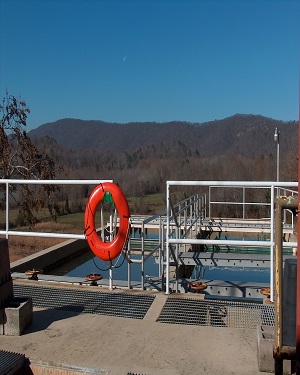
The treatment process is basically turbidity removal. A coagulant is added to the Raw Water to help settle out suspended particles before filtration. Filtration units are gravity flow through a bed of anthracite and sand. After filtration, final chemical addition is done: chlorine for disinfection; fluoride for the prevention of tooth decay; phosphate and caustic soda for corrosion control. Strict process control and laboratory quality testing is performed on the finished water to assure safe drinking water and maintain water quality within the standards set by the state regulatory commission. The Potable Water Distribution System has over 200 hundred miles of water mains to supply its customers in Roane and Morgan Counties